Can buyers purchase beans without ICE certification?
Yes. A grinder can buy beans directly from an exporter under a physical supply contract and process them into cocoa liquor, butter and powder. A chocolate maker can buy a particular origin for its flavour. A merchant can buy and store beans for resale. Each buyer can specify quality, origin and other terms. Organic or Fairtrade requirements, where relevant, serve a different purpose from exchange grading.
ICE grading matters when the owner wants to tender a qualifying lot against the New York futures contract. Commercial beans can go from origin to a processor without ever entering the certified count. Conversely, a certified lot can still be sold to a commercial buyer. Certification gives the owner a delivery option. ICE cocoa delivery rules ↗ · CBI guide to bulk cocoa buyers ↗ · Speciality cocoa buyers ↗.
How long from harvest to port arrivals and US stocks?
On the farm, fermentation usually takes four to seven days after the pods are opened. ICCO reports that West African sun-drying rarely finishes in under a week. For example, five days of fermentation and seven of drying puts the beans at day 12 after opening, before collection. Rain, the time between picking and opening, and the wait for a buyer can all extend that timeline. FAO/WHO Codex guidance ↗ · ICCO on drying in West Africa ↗.
At origin, dried beans may spend time at a cooperative or inland depot before a truck delivers them to port. The Ivorian arrivals series ↗ records the delivery week. It supplies neither the harvest date nor the date a vessel sailed. There is no verified national average for that interval in the sources used here.
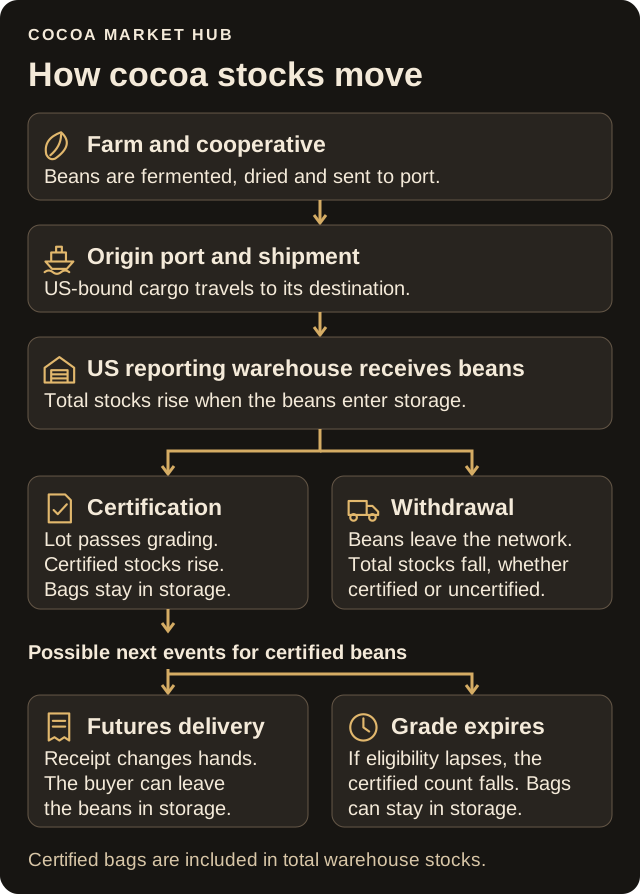
For a US-bound shipment, CargoRouter models about 34 days from Abobo, via Abidjan port, to a Philadelphia destination, including local transport and handling. This is one freight-planning example rather than an observed average for cocoa cargoes. In a worked example, 12 days of preparation followed immediately by that 34-day route gives about 46 days from pod opening to destination. Any time spent getting to Abobo or waiting before dispatch comes on top. See the route and its assumptions ↗.
At destination, beans enter the warehouse total on receipt into a reporting warehouse. Dockside arrival alone is insufficient. Certification has a separate clock: the owner must seek grading and the lot must qualify. Beans already in store can be certified later, or leave for a grinder without ever being certified. That is why shifting this week’s port arrivals forward by a fixed number of weeks cannot predict an ICE stock build. Track total and certified holdings by report date ↗.